Two things happened in Paradise Valley within the same stretch of 2026, and neither one is wrong.
Zillow's typical home value estimate for the town sat at roughly $3.02 million as of late July 2026, down 1.4 percent over the trailing year. That same summer, an estate on Mockingbird Lane closed for $40.24 million on July 9, 2026, an all-cash deal that broke the previous Arizona residential sales record of $33.5 million set in February 2025. If you are comparing Paradise Valley to Scottsdale or the Biltmore corridor and trying to decide what the town's price level actually is, you have just discovered why the median is the wrong tool for the job. It is not measuring one market. It is averaging two.
The Record That Doesn't Match the Median
The Mockingbird Lane sale was not an isolated outlier drifting away from the rest of the data. It arrived alongside confirmation from CoStar Group that the top quartile of single-family homes across the Phoenix metro rose 6.2 percent year over year in 2026, while lower price tiers stayed flat to up 1.9 percent, according to reporting on the sale. Frank Aazami, principal of the Private Client Group at Compass, told the same outlet that closings at $2,000 a square foot are now running roughly twice the pace they were the year before. Appraiser J. Andrew Turley, who has valued the Mockingbird Lane property multiple times since 2020, described the sale as pushing the market into a different tier entirely rather than simply setting a new ceiling on an existing one.
Read those three data points together and the picture is not one market appreciating. It is the top of the market pulling away from the rest of it while the broad base holds steady or softens slightly. A median calculated across both groups will always look muted, because it is diluting a genuine boom at the very top with a flatter reality underneath.
Why the Same Zip Code Produces Both Numbers
Paradise Valley's entire physical layout is built to produce exactly this kind of split, and the reason sits in the zoning ordinance itself, not in market sentiment.
The town's base residential district, R-43, requires a full acre of land per home, and it covers the large majority of Paradise Valley's platted land. That much most shoppers already sense. What fewer people account for is what an acre actually lets you build. Height limits scale with lot size, and Paradise Valley's scale runs lower than its neighbors at every tier that matters to a typical buyer.
| Lot size | Max building height in Paradise Valley | Standard limit in Scottsdale, Phoenix, or Mesa |
|---|---|---|
| Under 3 acres | 24 feet (not including chimneys) | 30 feet |
| 3 to 4 acres | 26 feet | 30 feet |
| 4 acres or more | 30 feet (including chimneys) | 30 feet |
On top of the height cap, a one-acre R-43 lot is held to a 25 percent floor-area ratio, which works out to roughly 10,890 square feet of allowable floor area before garages and porches are counted separately. Any lot with a slope of 15 percent or greater near Mummy Mountain, Camelback, or the Phoenix Mountain Preserve also triggers review by the town's Hillside Building Committee, a process that typically runs one to three meeting cycles before a project is cleared.
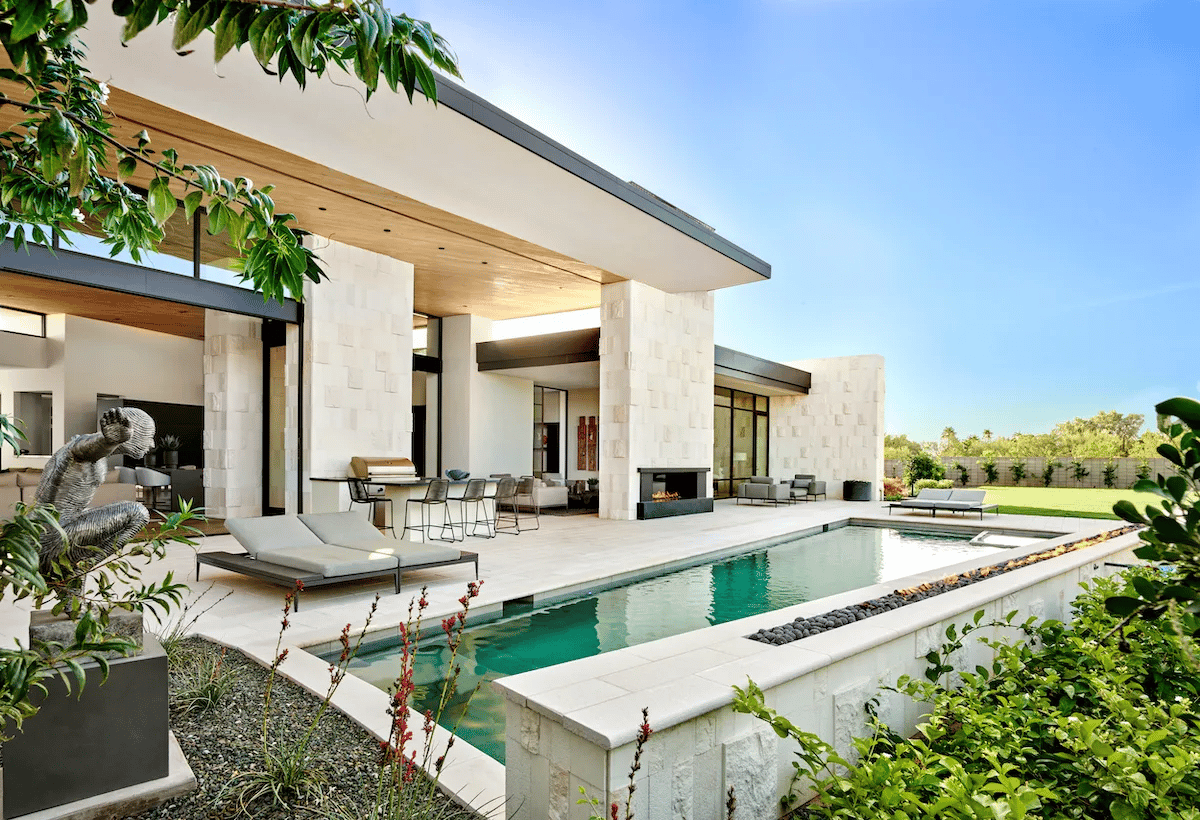
None of this stops a buyer from building a large, well-appointed home. It does mean that on the overwhelming majority of Paradise Valley's inventory, physical scale is capped in a way it is not in neighboring cities. The homes that reach the extraordinary price points sit on the rare parcels, three, four, five acres and up, where the height and floor-area math finally opens up. Everywhere else, the ceiling on both the roofline and the price is lower by design.
That is the mechanism behind the split. Trophy-tier land where the zoning math permits real scale is scarce and getting scarcer, so it commands aggressive premiums. The broad base of one-acre parcels is capped by the same rules that have governed the town since its 1961 incorporation, so it moves at a calmer pace. One median cannot describe both.
Where the New Money Is Actually Building
Land that clears Paradise Valley's larger-acreage thresholds is scarce enough that Compass agent Nate Waite, marketing a new four-home enclave near the Ritz-Carlton called Quail Run Manor, put it plainly when the roughly 10-acre, $30 million project cleared Town Council entitlement earlier this year.
"Raw land like this just doesn't exist in Paradise Valley. To get this combination of acreage and views in the heart of Paradise Valley you would have to tear down an existing home, and even in that case there are very few properties over 2 acres."
That scarcity is also why some of the most ambitious recent construction has landed just beyond Paradise Valley's own acre-lot grid rather than inside it. A 30-acre, 12-home canyon enclave called Crown Canyon, developed by BedBrock and marketed as adjacent to the town, has produced two Gold Nugget Merit Award-winning residences, Onyx and Jade, along with individual sales north of $30 million. When the largest available parcels inside Paradise Valley's boundary are this rare, builders chasing acreage-driven scale look at the edges.
What This Means When You're Comparing Comps
Paradise Valley closes something like 40 to 60 single-family homes in a typical month against 800 to 1,000 each in Scottsdale and Phoenix. That thin volume means a single $40 million closing or a cluster of $2,000-a-square-foot trophy sales can move the town's reported average meaningfully, while the same handful of transactions would barely register in a market that size elsewhere in the Valley.
Per-square-foot values across the 85253 zip code reached $987 in May 2026, up from $951 in April, according to a local market report, with hillside lots on the larger, less height-restricted parcels commanding $1,400 to $2,000 or more per square foot. Active inventory in June 2026 spanned 431 single-family homes in that same zip code, priced anywhere from a $229,000 teardown to multi-acre trophy estates, with a median list price of $5.25 million. That spread, a $229,000 lot and a $40 million sale inside the same market, is itself the clearest evidence that one number cannot describe this inventory.
If you are pricing a Paradise Valley listing against a comparable home in Scottsdale, the town's median is not a useful shortcut. The more reliable comparison starts with lot size and the zoning tier it falls into, then layers in price per square foot within that tier, rather than reading a single townwide number and assuming it describes any specific house you are considering.
A Few Quick Questions
Does a falling median mean Paradise Valley home values are actually declining? Not uniformly. The typical value measure reflects the broad base of the market, which has held roughly flat to slightly down over the past year even as the trophy tier, homes on larger parcels with fewer height and floor-area restrictions, has posted record-setting sales in the same window.
Why don't more large luxury subdivisions get built inside Paradise Valley itself? The supply of parcels large enough to clear the higher height and floor-area thresholds is limited, and much of it is already built out. That scarcity is part of why recent large-scale luxury projects, including a four-home enclave near the Ritz-Carlton and a 30-acre canyon community, have needed to assemble unusually large sites or locate just beyond the town's own acre-lot grid.
How should I compare a Paradise Valley listing to something in Scottsdale or the Biltmore corridor? Start with the lot's acreage and where it falls in the town's height and floor-area tiers, then compare price per square foot against similarly situated properties rather than against a townwide median, which blends a thin, high-volatility trophy segment with a much larger and steadier base market.
Reading Paradise Valley well means reading the zoning map alongside the price sheet. If you are weighing a purchase or a sale here and want that comparison done property by property rather than by headline, Merritt Estates can walk through what a specific lot's zoning tier means for its real position in this market. Book an appointment when you're ready to look past the median.